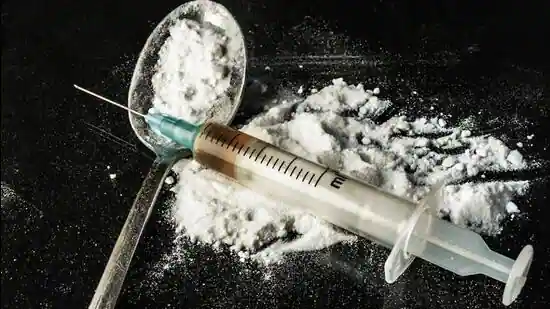
The government on Thursday told the Legislative Assembly that nearly 70,000 people — largely youth — are involved in substance abuse in Kashmir, with about 50,000 identified as heroin users, many of whom consume the drug through intravenous methods.
Replying to a question raised in the House by MLA Javid Riyaz, the Health & Medical Education Minister said Jammu & Kashmir is facing a serious challenge from narcotic drugs and psychotropic substances, describing the issue as a major social and public health concern.
According to a joint survey conducted in 2022 by the Health and Social Welfare departments across 10 districts of Kashmir, around 70,000 individuals were found to be using various substances, highlighting the scale of the crisis among young people.
The government said it has adopted a multi-pronged approach to address the problem, focusing on awareness drives, preventive interventions, stronger enforcement against drug trafficking, and expansion of treatment and rehabilitation services.
A network of de-addiction and rehabilitation centres has been established across the Union Territory, including facilities in district hospitals, government medical colleges and police-run centres.
The Minister said nearly 69,000 patients have so far received treatment and rehabilitation at these facilities across J&K.
The Assembly was informed that free services — including OPD and IPD care, emergency treatment and Opioid Substitution Therapy (OST) — are available at medical colleges and district hospitals through Addiction Treatment Facilities.
At present, 1,864 clients are registered, with 358 actively receiving treatment.
Mental Health and Addiction Medicine Clinics have also been operationalised to provide specialised care, while awareness and IEC campaigns are being carried out under national programmes such as NHM, NMHP, NAPDDR and the Nasha Mukt campaign in educational institutions and community settings.
The Drug Control Organization has stepped up enforcement and awareness efforts, conducting 518 awareness programmes during 2025–26 (till December). Authorities have also publicised Helpline 104 for immediate counselling and assistance.
The government said de-addiction counselling and rehabilitation infrastructure is being strengthened, particularly in rural and vulnerable areas. Institutions such as the Institute of Mental Health and Neurosciences Kashmir and various government medical colleges are expanding specialised services and inpatient care.
Addiction Treatment Facilities at Government Medical College Srinagar, Government Medical College Anantnag and Government Medical College Handwara are fully functional, providing counselling, OST programmes, outreach and referral services.
Meanwhile, Government Medical College Baramulla has been sanctioned ₹5 crore for a dedicated de-addiction building, while drug treatment centres across the UT continue to offer structured treatment and follow-up care.
Reaffirming its commitment, the government said institutional mechanisms for prevention, treatment and rehabilitation are in place and are being strengthened systematically to address drug abuse, especially among youth, stressing that early intervention and community participation remain crucial to tackling the crisis.