



Indus Waters Treaty suspension: Challenges behind India’s tough stand

By Ch. Sompal Shastri and R.N. Malik
On the fateful day of 22 April 2025, a group of terrorists from Pakistan crossed the border and reached Pahalgam in Jammu and Kashmir and resorted to indiscriminate firing, resulting in the deaths of 26 Indian tourists. Consequently, the whole nation was shocked and clamoured for revenge. The Government of India too reacted strongly. Besides conducting Operation Sindoor, it urgently suspended the Indus Waters Treaty (IWT) with Pakistan. The Union Home Minister, Sh. Amit Shah, further declared that not a drop of water from the three upper rivers of Indus basin (Indus, Jhelum and Chenab) would be allowed to flow towards Pakistan.
The total annual flow of six rivers (Indus, Jhelum, Chenab, Ravi, Beas and Satluj) has been assessed to be 170 million acre feet (MAF) and the flow gathered for these six rivers from the Indian territory is around 123.0 MAF. The total annual run-off of three lower or Punjab rivers (Ravi, Beas and Satluj) is estimated to be 33 MAF. Before the Partition, a part of the flow of the three Punjab rivers was shared by some districts of Pakistan. Consequently, after Partition.(15.8.1947), an accord was reached between the two countries on May 8,1948, that allowed Pakistan to utilise the flow as before till a final accord was reached for the distribution of waters of all the six rivers.
After lot of haggling for eight years under the auspices of the World Bank, the Indus Waters Treaty was drafted and signed by the two countries on 19th September 1960. According to the Treaty, flow of 33 MAF of the three Punjab rivers (Ravi, Beas and Satluj) was allotted to. India for her exclusive use and the flow of 90 MAF of three upper rivers (Indus, Jhelum and Chenab) was allotted to Pakistan for exclusive use for various uses. Besides, 1.5 MAF water from Chenab river could be used for.irrigation of lands in the Jammu region. However, India could utilise the waters of the three rivers for hydropower development with the help of run-of-the-river projects.
On paper, the Treaty looked to be a total sellout to Pakistan but it was not so as believed in practical terms. This is because India could use only a limited quantity of flow from river Chenab in view of the unfavourable topographical conditions prevailing in the J&K region. Pakistan too could not utilise the flood water of Chenab fully as the site for building a storage reservoir did not exist in her territory and the excess flood water (around 12-14 MAF) still flows to the Arabian Sea unutilised.
Moreover, the reservoir at the Tarbela dam across the Indus in Pakistan too is unable to store the entire flow of the Indus because of a very high peak flow of around 20 lakh cusecs during the rainy season and a substantial part has to be spilled over few times causing floods in the downstream side. Secondly, water of both the Jhelum and Chenab rivers contains a high concentration of silt. As a result, the proposed storage reservoirs across the two rivers run the risk of heavy siltation and consequent reduction in the storage capacities in the two reservoirs in the long run. Pakistan is facing this problem in the two reservoirs of Mangla and Tarbela dams across Jhelum and Indus rivers respectively.
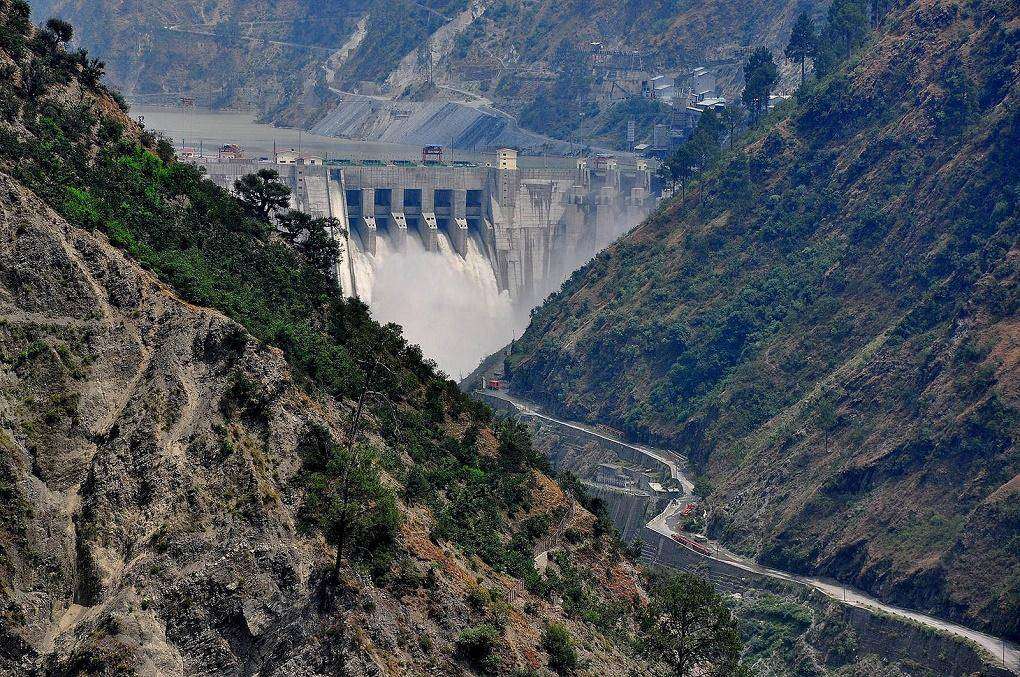
Thirdly, an adequate storage space is not available in the valleys of the three upper rivers on the Indian side because of their narrowness. For example, total storage space created by the 143 m high Baglihar dam across Chenab is only 0.4 billion cubic metres (bmc) as against the 7.3 bmc storage capacity of the 165m high Bhakra Dam reservoir. Fourthly, diversion of waters of the Indus and the Jhelum rivers to river Chenab requires very long and spacious tunnels to carry an annual flow of 67 MAF (45 MAF from the Indus and 22 MAF from the Jhelum). The tunnel length between Indus and Chenab river at Akhnoor barrage is around 280km and between Jhelum and Chenab rivers is 110km. Construction of such long and big tunnels across high and freezing mountainous reaches is definitely an herculean task. Besides, the length of the open lined channel carrying combined flow between Chenab and Beas rivers will be around 145km. Therefore, considering the grave difficulties and the economy of scale, the term “utilisable water” was mentioned in the Treaty referring to the limitations of flow utilisation of the three rivers and possibly, the then government of India agreed to the provisions of the Indus Water Treaty of 1960 in view of the aforesaid limitations. Still, the engineers of the Central Irrigation and Power Commission should have advised the government to insist for a fair share in the flow of river Chenab as well.
Both the Home Minister Amit Shah and the Jal Shakti Minister C.R.Patil have stated a few times that the Jal Shakti Ministry had been tasked with the preparation of the Feasibility Report for the proposed mega project for diversion of total flow of the three upper rivers to river Beas for further utilisation in Haryana, Punjab, Rajasthan and Gujrat states. But one year has passed and nothing has been heard so far about the progress and the technical details of the proposed mega project. However, some scanty reports appeared in the media last year that initially a long open channel of nearly 145km length will be built to transfer the flow of Chenab river to river Beas for further utilisation in the Punjab and Haryana States. But strangely, there was no mention of building a storage reservoir across Chenab river for storing the flood waters to ensure a regular flow round the year.
The aforesaid limitations indicate that the diversion of the entire flow of 90 MAF from the three upper rivers to river Beas has very distant possibility though the possibility of diversion of partial or dry weather flow from river Chenab exists considering the cost-benefit ratio of the project.
Incidentally, the Home Minister Amit Shah and External Affairs Minister S. Jaishankar have stated a few times that the Indus Water Treaty would remain in suspended animation till Pakistan stops cross-border terrorism completely. This bland statement creates some confusion. Suppose, Pakistan genuinely stops the cross- border terrorism; then will the Government of India revive the Treaty and allow the water of the three upper rivers to flow towards Pakistani or will re-negotiate the Treaty to India’s advantage. This confusion too needs to be cleared quickly. However, it may be mentioned that suspension of the Treaty has given a filip to the early completion of half a dozen upcoming hydropower projects across river Chenab and Jhelum as the country no longer requires to seek approval of design and drawings from the Pakistani engineers as per provision in the Treaty. This condition alone delayed the construction work of the hydropower projects at least by three years in the past.
(Ch.Sompal was Agriculture Minister in Vajpayee government and later member Planning Commission government of India. Prof. RN Malik retired as Engineer-in-Chief from Public Health department Haryana). (Opinions expressed in the article are those of the author and not of the publication)