




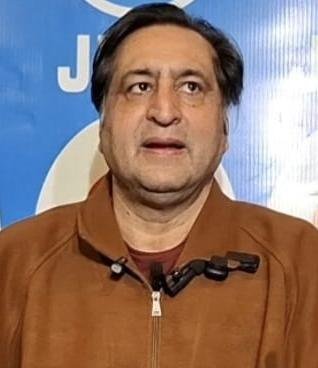
Lone accuses regional imbalance in issuance of EWS certificates in J&K

J&K Peoples Conference President and Handwara MLA Sajad Lone on Wednesday raised the issue of EWS (Economically Weaker Sections) certificates in the J&K Assembly, accusing a stark regional imbalance in how they are issued. He demanded a single, uniform definition of poverty across the Union Territory.
Lone countered with the government’s own data. The Food, Civil Supplies and Consumer Affairs Department records over 37 lakh AAY and BPL priority household ration cards in Kashmir against about 29 lakh in Jammu. Yet in the past year, he said, roughly 24,000 EWS certificates went to Jammu and only about 2,400 to Kashmir, a split of nearly 92% to 8%.
“The per capita is the same and the social conditions are the same,” Lone told the House, noting the two regions have shared a common history for centuries. He identified the asset criteria as the core problem. Someone earning under ₹8 lakh a year may be deemed poor, yet owning a house on three and a half marlas can make them “rich.” A person who qualifies as poor for a ration card, he said, is treated as well-off when applying for a job.
Citing replies he received in the Assembly, Lone said about 7,500 recruitments have been made since the government took office, and roughly 750 went under EWS. Under a ration-card-based criterion, he said, those posts would have split 412 to Kashmir and 337 to Jammu.
With around 40,000 recruitments pending, about 4,000 would fall under EWS. By his calculation, the current asset-based criteria would send about 320 of those posts to Kashmir and 3,680 to Jammu, while an AAY/BPL-based criterion would send about 2,200 to Kashmir and 1,800 to Jammu.
Lone argued that existing reservations already crowd Kashmiri youth out of the job market, and that the EWS imbalance compounds this. “There is no rocket science in this,” he said, challenging any economist or statistician to explain the disparity.
Lone pointed to Kerala, which uses AAY and BPL ration card status as its EWS yardstick, and offered to hand the Kerala form to the Speaker and the Minister.
He also argued the matter is not constitutionally binding on the UT. Article 16 lets states notify economically weaker sections by family income and other indicators, and the Centre’s 2019 DoPT definition, he said, can continue for central jobs while J&K adopts its own for UT posts.
“A poor person is one who holds a priority household ration card or an AAY card,” Lone said, urging the government to adopt one definition for both employment and food and supplies. “You cannot have two definitions.”