




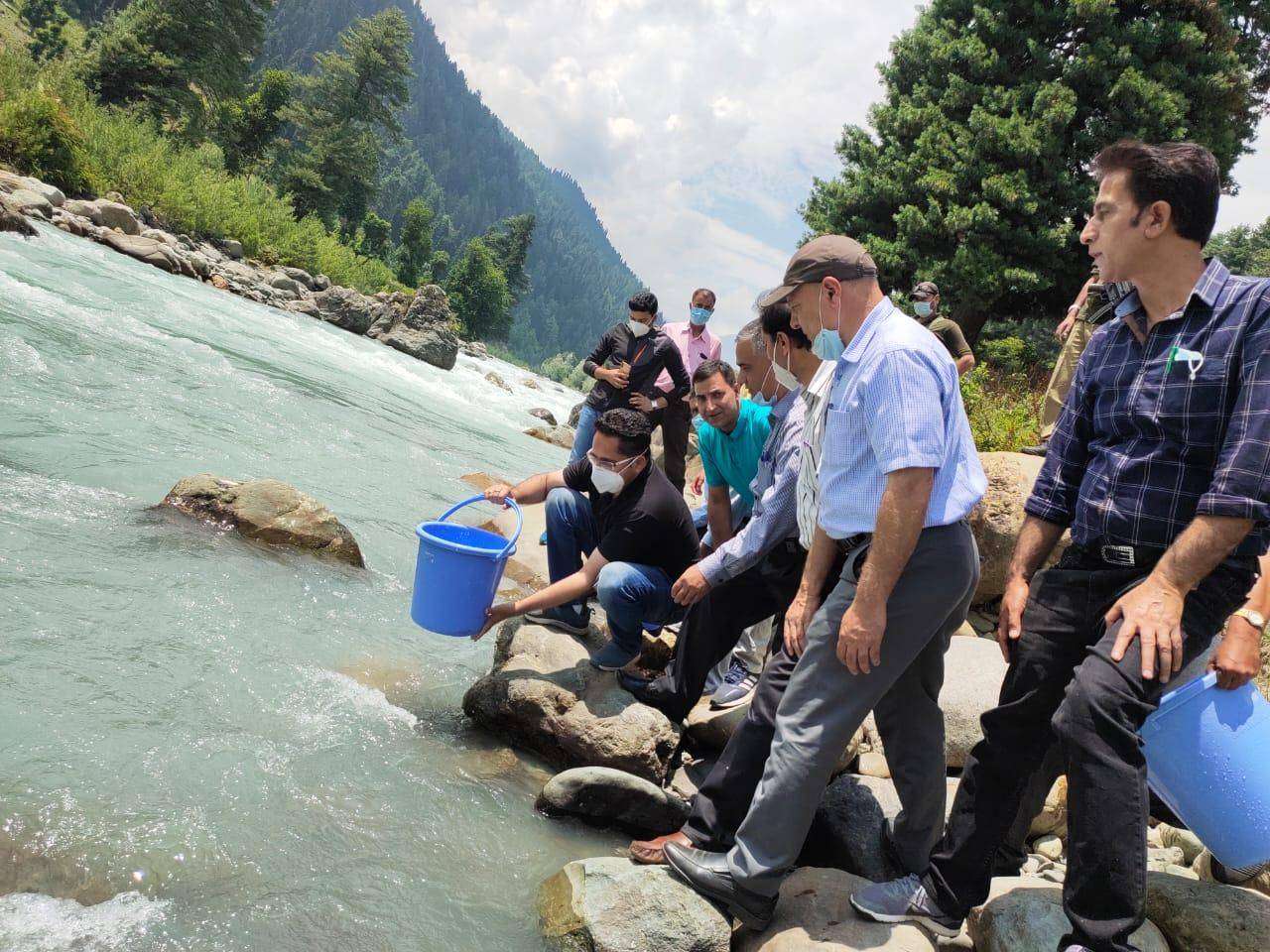
Breakthrough in captive breeding of snow trout achieved by SKUAST-K scientists

In a major boost to freshwater fish conservation in Jammu and Kashmir, scientists at Sher-e-Kashmir University of Agricultural Sciences and Technology of Kashmir (SKUAST-K) have successfully standardized an induced-breeding and larval-rearing protocol for the vulnerable Himalayan snow trout (Schizothorax plagiostomus), locally known as Khont.
The breakthrough, achieved by scientists of the Divisions of Fisheries Resource Management and Fish Genetics and Biotechnology, Faculty of Fisheries, is expected to pave the way for captive seed production, river-restocking and restoration of declining wild populations of the indigenous cold-water fish.
The research team, led by Prof. (Dr.) Farooz Ahmad Bhat, Dean, Faculty of Fisheries, SKUAST-K, successfully induced spawning of mature snow trout broodstock under controlled conditions using an optimized hormonal protocol. The scientists recorded high fertilization, hatching and larval-survival rates, demonstrating the feasibility of producing quality seed of the species under captive conditions.
The achievement assumes significance as natural populations of snow trout have declined considerably over the years owing to habitat degradation, water pollution, riverbed mining, construction activities, overexploitation, climate change and disruption of natural breeding grounds.
The species is also facing growing ecological pressures amid concerns over fish mortality incidents reported from different parts of Kashmir, including Panzath Nag in Qazigund, Sherbagh, Ganderbal and Verinag in Anantnag. Scientists, however, stressed that the causes of individual mortality events require detailed scientific investigation.
According to the research team, captive breeding of S. plagiostomus has remained challenging because of its specialized habitat requirements and the limited availability of mature broodstock in the Jhelum during the natural spawning season. The standardized protocol now provides a dependable approach for seed production and opens up possibilities for conservation breeding, stock enhancement and sustainable aquaculture.
Developed under the Holistic Agriculture Development Programme (HADP), the technology is expected to support future river-restocking programmes and reduce dependence on wild stocks, while strengthening efforts to conserve Kashmir’s native aquatic biodiversity.
Congratulating the scientists, Vice-Chancellor, SKUAST-K, Prof. Nazir Ahmad Ganai, said the achievement goes beyond a scientific milestone and represents an important contribution towards safeguarding Kashmir’s native aquatic biodiversity.
He expressed confidence that continued collaboration among research institutions, the Department of Fisheries and local communities would help translate captive seed production into effective conservation and restoration programmes for Himalayan freshwater ecosystems.
The breakthrough reinforces SKUAST-K’s commitment to developing science-based and sustainable solutions for conserving Jammu and Kashmir’s cold-water fisheries resources and aquatic biodiversity.