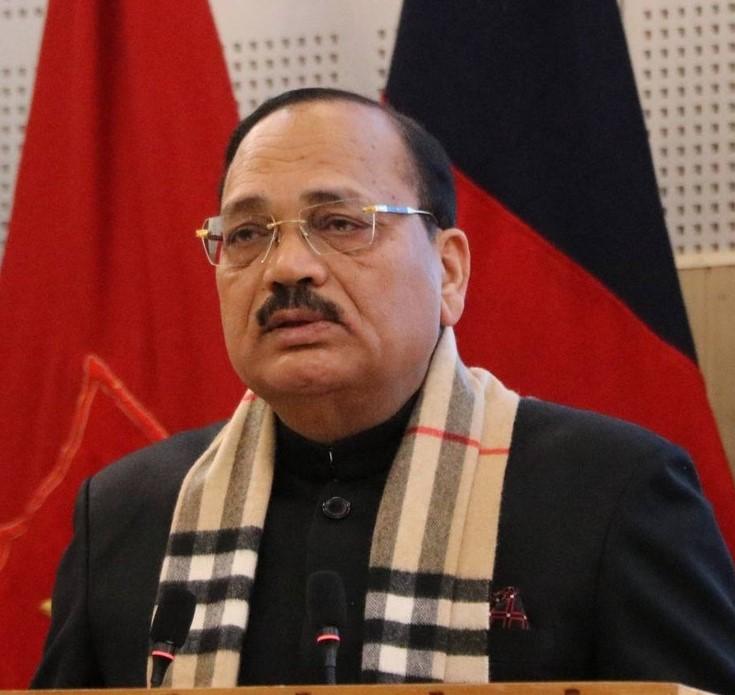
In a historic first, Chief Justice of India Justice Surya Kant addressed Army personnel in Leh, underlining that access to justice must extend to soldiers posted in remote and operationally sensitive regions. Emphasising the judiciary’s commitment to defence personnel and their families, he remarked that “the law must travel to the soldier, because the soldier cannot always travel to the law.”
The Chief Justice interacted with officers and troops of the Fire and Fury Corps at the Raina Auditorium, highlighting the importance of strong institutional synergy between the judiciary and the Armed Forces.
This is the first time a sitting Chief Justice of India has addressed armed forces personnel at a base camp in Leh. In his address, Justice Surya Kant pointed out that soldiers often grapple with legal and personal challenges while serving in far-flung, high-altitude areas, where accessing courts and legal services is not always feasible. He noted that unlike civilians in cities—who can easily approach courts and lawyers—soldiers deployed in such terrains cannot leave their posts to attend to litigation or resolve disputes back home.
The programme was attended by Lieutenant Governor of Ladakh Vinai Kumar Saxena; Chief Justice of the High Court of Jammu & Kashmir and Ladakh Justice Arun Palli; Justices Sanjeev Kumar, Sindhu Sharma and Shahzad Azeem; Chief Secretary Ladakh Ashish Kundra; Director General of Police Ladakh Mukesh Singh; and Lieutenant General Hitesh Bhalla, among other senior officials.
Lieutenant General Hitesh Bhalla, General Officer Commanding, Fire and Fury Corps, in his welcome address, termed it a privilege to host the guardians of the nation’s judicial system. He reaffirmed the steadfast commitment of the Armed Forces towards safeguarding national integrity, while also extending support to the Indian judiciary.
In his address, Justice Arun Palli, Chief Justice of the High Court of Jammu & Kashmir and Ladakh, observed that the sacrifices made by the Armed Forces are beyond comparison and deserve the highest degree of respect, sensitivity, and prompt responsiveness. He also highlighted that after the launch of NALSA’s Veer Parivar Sahayata Yojana at the North Zone Conference held at SKICC, Srinagar, in July last year, a new direction and momentum were given to efforts to make the legal system more accessible. He noted that since the conference, 205 AFT matters have been disposed of in the High Court alone and also shared how the appointment of Veer Naris has strengthened the legal aid movement in India.
The Chief Justice of India paid tribute to the supreme sacrifices of soldiers, recalling the historic legacy of Rezang La. Emphasising that justice must reach the soldier, He reiterated that access to justice under Article 39A of the Constitution of India is a fundamental right. He highlighted key legal aid initiatives, including Veer Parivar Sahayata Yojana and Nyaya Aapke Dwaar, aimed at ensuring legal support to Armed Forces personnel and their families, particularly in remote and far-flung areas.
The CJI further stressed the importance of a trained paralegal workforce and encouraged the inclusion of paralegal volunteers within Army units. He also observed that ex-servicemen willing to contribute are welcome to join as paralegal volunteers. The CJI additionally noted India’s advancements in leveraging technology, including the use of Artificial Intelligence for translation across multiple languages, thereby enhancing access to justice.
During the interactive session, Army personnel were provided an opportunity to raise their queries directly. The discussion primarily focused on ensuring access to justice for soldiers stationed in remote border areas, as well as on professional growth in the legal field. The CJI, in response, mentioned that various schemes and initiatives such as Veer Parivar Sahayata Yojana and Nyaya Aapke Dwaar are aimed at helping and providing legal assistance to all Army personnel, ex-servicemen, and their families. He also stated that cases can be filed in courts online from anywhere. The Indian judiciary is number one in the usage of technology to deliver justice to all across the world.
He also emphasised the importance of patience, dedication, and a spirit of service in the legal profession for the younger generation when asked for advice on achieving success in any profession.
The meet-and-greet session concluded with a vote of thanks by Major General Sudhanshu Sharma, Chief of Staff, Fire and Fury Corps.
The proceedings were followed by a Barakhana with troops at Sonam Wangchuk Stadium, featuring Martial Arts performances including the Khukri Dance by Gorkha troops, Spao Dance, Kalaripayattu and Gatka by troops of Fire and Fury Corps. The programme also included felicitation of participants and an interaction with officers, JCOs, and other ranks.