




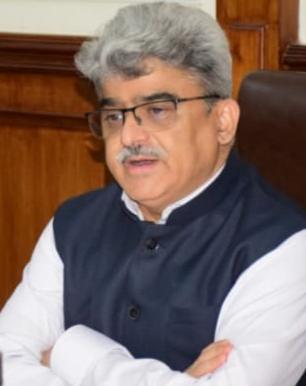
Dulloo asks departments to fast-track citizen-centric digital initiatives

Chief Secretary, Atal Dulloo, today chaired a high-level review meeting to assess the progress of various Information Technology (IT) and e-Governance projects being implemented across multiple departments of the Government of Jammu and Kashmir taken-up in collaboration with the Bhaskaracharya National Institute for Space Applications and Geo-informatics (BISAG-N).
The meeting besides the Commissioner Secretary, IT, Saurabh Bhagat; and Special Director General, BISAG-N, Vinay Thakur; was attended by the concerned Administrative Secretaries, Heads of Departments, senior police officers, representatives from the National Informatics Centre, and other stakeholder agencies.
A comprehensive department-wise review was undertaken to evaluate the implementation status of ongoing digital governance projects, identify bottlenecks, review timelines and accelerate completion of technology-enabled initiatives aimed at improving governance, enhancing transparency and making public services more accessible, efficient and citizen-friendly.
During the meeting, the Chief Secretary underscored that digital transformation is a key pillar of governance reforms and directed departments to ensure close coordination with BISAG-N for timely completion of all pending modules. He emphasized that every digital intervention must ultimately translate into improved public service delivery, simplified procedures, enhanced accountability and greater convenience for citizens.
He further emphasized that all technology-enabled projects should remain focused on improving ease of living for citizens by ensuring transparent, efficient and time-bound delivery of public services.
He took the occasion to impress upon the departments to adhere strictly to project timelines and ensure seamless integration of departmental databases for effective implementation of digital governance initiatives. He stressed the need for continuous monitoring, timely resolution of technical issues and adoption of emerging technologies, including Artificial Intelligence, wherever feasible to improve governance outcomes.
Reviewing the progress of the Finance Department’s AI-based GST Analytics and Fraud Detection Portal, the meeting was informed that the platform has significantly strengthened tax compliance through advanced analytics and fraud detection mechanisms. More than 4,300 notices have been issued based on analytics generated by the portal, resulting in substantial revenue recovery. The system has also been strengthened through enhanced reporting modules, Action Taken Report monitoring and improved processing capabilities.
While reviewing the End-to-End Energy Tracking and Management System (EETMS) of the Power Development Department, the meeting was informed that the project has entered the operational deployment phase with live dashboards, role-based access and Management Information System (MIS) reports across power sector corporations. API-based data integration and automated alerts are being operationalized, while future phases will incorporate Artificial Intelligence and Machine Learning for demand forecasting, predictive maintenance and advanced decision support.
The meeting also reviewed the implementation of the Integrated Mining Surveillance System (IMSS) developed for the Mining Department. The project uses satellite imagery and geo-spatial technologies for detection of illegal mining activities and GPS-enabled monitoring of mineral transportation vehicles. Thousands of mineral transport vehicles have already been integrated with the surveillance platform, enabling automated alerts and improved enforcement.
Reviewing initiatives in the School Education Department, the meeting was informed that the JK e-Pathshala Educational Television Channel is broadcasting curriculum-based educational content round the clock and has considerably expanded access to quality learning resources, particularly for students in remote areas.
The Tourism Department presented the progress achieved in development of the redesigned JK Tourism Web Portal and Mobile Application, equipped with an AI-powered chatbot, integrated tourist information, itinerary planning, hotel and transport onboarding and digital payment facilities. The platform is expected to significantly improve the overall visitor experience while promoting tourism destinations across the Union Territory.
The meeting also reviewed progress on several important digital initiatives of the Agriculture Production Department, including Kisan Khidmat Ghar, Kisan Sathi, Daksh Kisan and the JKCIP Portal, which are aimed at strengthening digital agriculture services, improving scheme implementation, enhancing monitoring mechanisms and providing technology-enabled support to farmers.
Reviewing the JK Samadhan grievance redressal platform, the Chief Secretary was informed that substantial progress has been achieved in addressing system improvements and implementation of new functionalities. He directed the concerned agencies to ensure expeditious completion of all remaining action points to further strengthen public grievance redressal.
The Revenue Department presented the status of modernization of land records, digitization of Jamabandis, workflow automation and mutation management systems designed to improve transparency, efficiency and accessibility of revenue services.
The meeting also reviewed the implementation status of several other important digital governance initiatives, including the Single Window System for Recruitment Rules, Unified Cooperative Dashboard, PMAY-Urban 2.0 Household Survey Application, Mission YUVA Mobile Application, JK SeHAT Mobile Application, District Good Governance Dashboard, Digital Digest of Statistics, Village Planning Portal, Family ID Project, Industrial Mapping Application, Forest e-Behak System, Anganwadi GIS Tracking Platform, PWD Digital Project Monitoring System, Youth Engagement Portal and other GIS-enabled platforms being developed for various departments.
The meeting concluded with detailed directions for early completion of pending deliverables, enhanced inter-departmental coordination and periodic review of all ongoing digital governance projects to ensure their timely operationalization across the Union Territory.