

Opinion Article: “From the Mysterious Munis of the Rigveda to Mahadeva of Kailash: Tracing the Ancient Roots of Shaivism”

(Netra Kumar Sharma)
The journey of Rudra—from a mysterious Vedic presence associated with ascetics and the mountains to Mahadeva, worshipped across the length and breadth of India—may preserve the memory of a remarkable religious synthesis.
There are moments in ancient literature when a few lines seem to open a window into a world much older and stranger than the organised religious traditions familiar to us today. One such moment occurs in the tenth Mandala of the Rigveda, in Rigveda 10.136, traditionally known as the Keśin Sūkta—the hymn of the long-haired ascetic.
Its opening verses describe the Keśin, the long-haired one, and the Munis, extraordinary ascetics who appear to live beyond the ordinary boundaries of society. Verse 10.136.2 describes them as vātaraśanāḥ—“girdled by the wind”—wearing garments of a tawny or soiled colour and following the movement of the wind. The following verses portray them as ecstatic, moving through the atmosphere, sharing in the work of the gods and travelling along paths associated with wild creatures and supernatural beings.
Then comes the remarkable final verse, Rigveda 10.136.7:
Vāyur asmā upāmanthat pinaṣṭi smā kunannamā |
Keśī viṣasya pātreṇa yad rudreṇāpibat saha ||
In one influential modern translation, the sense is: Vāyu prepares or churns something for the long-haired ascetic, and the Keśin drinks from a vessel of viṣa together with Rudra. The wording and interpretation are difficult, and translations differ. The Sanskrit uses viṣa, commonly meaning poison; it does not unambiguously identify the substance as Soma, cannabis or any known intoxicant. Nevertheless, the association is striking: a mysterious long-haired ascetic, an extraordinary drink, Vāyu, and Rudra appear together in the same Vedic hymn.
This is not proof that the later Shaiva ascetic order already existed in the Rigvedic age. Nor does the hymn explicitly place these Munis in the Himalayas. But it is significant evidence that the Vedic world knew of an unusual ascetic figure whose imagery and association with Rudra invite comparison with later Shaiva traditions. Jamison and Brereton, in their scholarly translation of the Rigveda, themselves note that the hymn has been regarded as a possible precursor to later extreme ascetic practices and the Rudra–Śiva cult—while cautioning that this is an interpretation, not a demonstrated historical line.
Rudra, the lord of the mountains
A second important strand appears in the Krishna Yajurveda’s Taittirīya Saṃhitā, 4.5, the celebrated Śrī Rudram or Rudra Praśna. Here Rudra is no longer merely a fearsome Vedic power invoked for protection. He is addressed through an extraordinary range of forms and places.
The opening section, particularly Taittirīya Saṃhitā 4.5.1–5, contains the expressions Giriśanta, Giriśa and Giritra—terms traditionally understood in relation to the mountains or as referring to the one who dwells in, or is lord of, the mountains. The hymn asks Rudra to make his weapons benevolent and to reveal his peaceful form.
This is an important textual bridge. In the Rigveda’s Keśin hymn we encounter Rudra alongside an extraordinary ascetic; in the Yajurvedic Rudra litany we encounter a powerful deity addressed through mountain-associated names. These are two distinct pieces of evidence, not a single passage narrating the birth of Shaivism. And the text does not name Mount Kailash or say that Rudra worship began in the Himalayas. Yet the mountain association is undeniably present in the Vedic tradition.
The possibility deserves serious consideration: could ancient mountain communities, forest-dwelling ascetics and local nature-deity traditions have contributed to the religious world in which Rudra was worshipped and eventually understood as Śiva?
From Rudra to the supreme Śiva
The transformation of Rudra into the supreme Śiva is visible in later Vedic and Upanishadic literature. The Śvetāśvatara Upaniṣad, particularly chapters 3 and 4, presents Rudra as the one supreme divine reality, the source and ruler of the universe. This is a major theological development: the fierce and unpredictable Rudra of earlier Vedic hymns is increasingly understood as the highest principle, not merely one deity amongj many.
The word Śiva, meaning auspicious or benevolent, also becomes central to this developing understanding. Over centuries, Rudra and Śiva become closely identified, and diverse strands of worship, philosophy, ritual and ascetic practice develop into the many Shaiva traditions.
It would be too simple to claim that this entire transformation happened in the Himalayas. The history of Indian renunciation is debated. Some scholars emphasise developments within Vedic culture; others, notably Johannes Bronkhorst, have argued for important contributions from the wider Greater Magadha cultural world. The earliest evidence does not establish one exclusive birthplace for Indian asceticism. A Himalayan contribution is a plausible avenue of research, not a settled conclusion.
The Himalayas become sacred geography
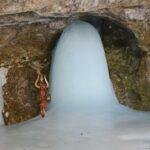
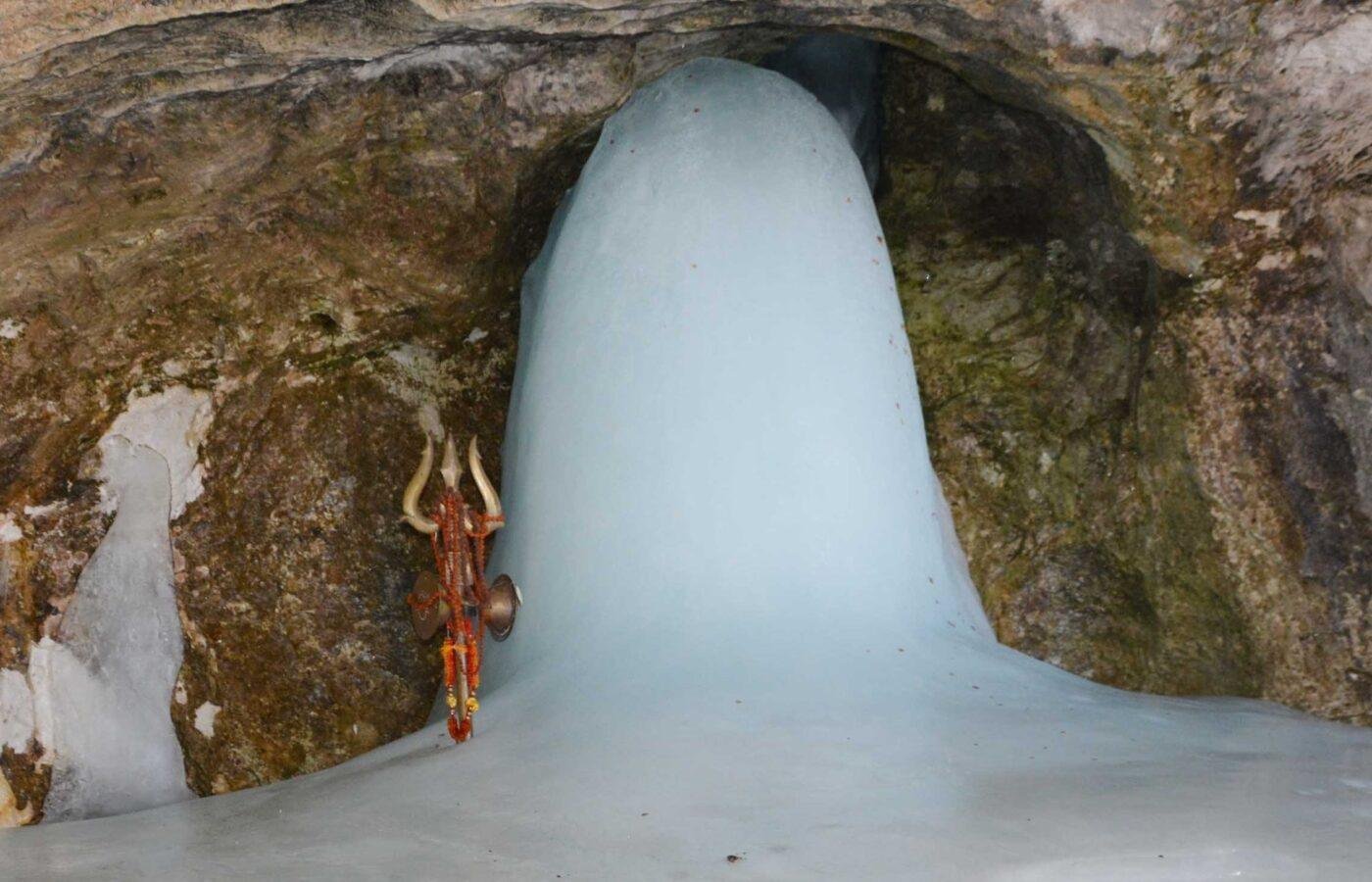
As Shaiva traditions developed, the mountains became central to their sacred imagination. Kailash, the abode of Śiva in later Hindu tradition, became the supreme mountain symbol. Amarnath in Kashmir, with its ice-lingam tradition, became one of the most celebrated Himalayan centres of Śiva worship. The wider Kashmir region developed profound Shaiva philosophical schools, including Trika and Pratyabhijñā, whose thinkers explored Śiva as consciousness itself.
Across Jammu and Himachal, sacred landscapes, caves, springs, peaks and shrines became part of a living religious geography. These traditions cannot all be dated to the Rigvedic period, and the later prominence of a pilgrimage site cannot by itself prove that it was a centre of Rudra worship thousands of years earlier. But they demonstrate how deeply the mountain landscape became woven into the religious identity of Śiva.
The union of Śiva and Śakti: from the mountain ascetic to the cosmic household
The story of Śiva and Sati, preserved in later epic and Purāṇic traditions, adds another dimension to this religious evolution. Sati, daughter of Dakṣa Prajāpati, marries Śiva against her father’s wishes. When Dakṣa performs a great sacrifice and deliberately excludes Śiva, Sati attends despite her husband’s warning. Faced with her father’s insult to her husband, she gives up her body through yogic power in the best-known versions of the story.
Śiva’s grief and fury shake the cosmic order. From his matted locks emerges Vīrabhadra, who attacks Dakṣa’s sacrifice and destroys the sacrificial assembly. In many familiar versions, Dakṣa is later restored to life with the head of a goat. Śiva’s grief-stricken journey with Sati’s body leads, in the later Śakti-Pīṭha tradition, to the emergence of sacred sites across the subcontinent where parts of her body or ornaments are believed to have fallen.
The details vary across Purāṇic accounts: Sati’s death, the destruction of the sacrifice and the development of the Śakti-Pīṭha lists are not presented identically in every text. These are religious narratives, not contemporary historical records of a datable event. Their importance lies in what they express: the reconciliation and interdependence of ascetic Śiva, the sacrificial world represented by Dakṣa, and the creative divine power of Śakti.
The geography of this tradition is remarkable. In the north-east, Kāmākhyā in Assam became a major centre of Śākta worship. In the north-west, Jvālāmukhī in Himachal is associated with the living flame of the Goddess. In the Himalayan region, Vaishno Devī became one of India’s most important centres of devotion to the Goddess, although its status and lists differ from the classical Śakti-Pīṭha catalogues. In the south, the Śiva–Śakti relationship flourished at Śrīśailam, with Mallikārjuna and Bhramarāmbā; at Kāñcīpuram, with Ekāmranātha and Kāmākṣī; and at Madurai, where Sundareshvara and Mīnākṣī embody the inseparability of Śiva and the Goddess. These sites belong to varied regional and textual histories; they should not all be treated as evidence of one identical ancient cult.
The same broad religious synthesis is visible in Śiva’s spread across India: the early historic Gudimallam liṅga in Andhra Pradesh is among the important early material witnesses to liṅga worship, while later temples and pilgrimage networks in both northern and southern India show how Shaiva traditions became deeply rooted across regions. The liṅga, temple ritual, Purāṇic narratives, devotional poetry and philosophical schools helped make Śiva worship a pan-Indian tradition.
A conclusion written in the landscape of time
Perhaps the most responsible conclusion is not that Śiva worship began at one Himalayan cave, nor that a single Vedic hymn records the complete origin of Shaivism. It is that the evidence points towards a long and complex process.
The Rigveda preserves the extraordinary image of the wind-girt Muni and his association with Rudra. The Yajurveda’s Śrī Rudram gives Rudra mountain-associated names and an increasingly expansive religious presence. The Upanishads elevate Rudra towards the supreme reality. Later Shaiva and Śākta traditions give this divine world its temples, philosophical systems, pilgrimage routes and powerful narratives of Śiva and Śakti.
It remains possible that ancient Himalayan and other forest or mountain communities contributed to this development. It is equally important to investigate the Indus and north-western regions, the Vedic ritual world, and the ascetic cultures of the Gangetic and Greater Magadha regions. The available evidence does not yet allow historians to draw one unbroken line from a prehistoric Himalayan cult to the Śiva worship of today.
But one thing is clear: the history of Śiva is not merely the history of a deity in a temple. It is also the history of the Indian imagination—of mountains and forests, wandering ascetics and Vedic hymns, sacrifice and renunciation, destruction and renewal, and the eternal union of Śiva and Śakti.
From the mysterious Keśin of the Rigveda to Mahādeva of Kailash, and from the Himalayan shrines to the great temples of the South, the story of Śiva is a story of continuity through transformation. Its deepest origins may still be hidden in the mountains of time; the task of history is to explore them without confusing faith, memory and evidence. (The views in the article are of the writer and not JK Newsline)