


LG Sinha stresses new healthcare model with AI, genomics, robotic surgery in J&K

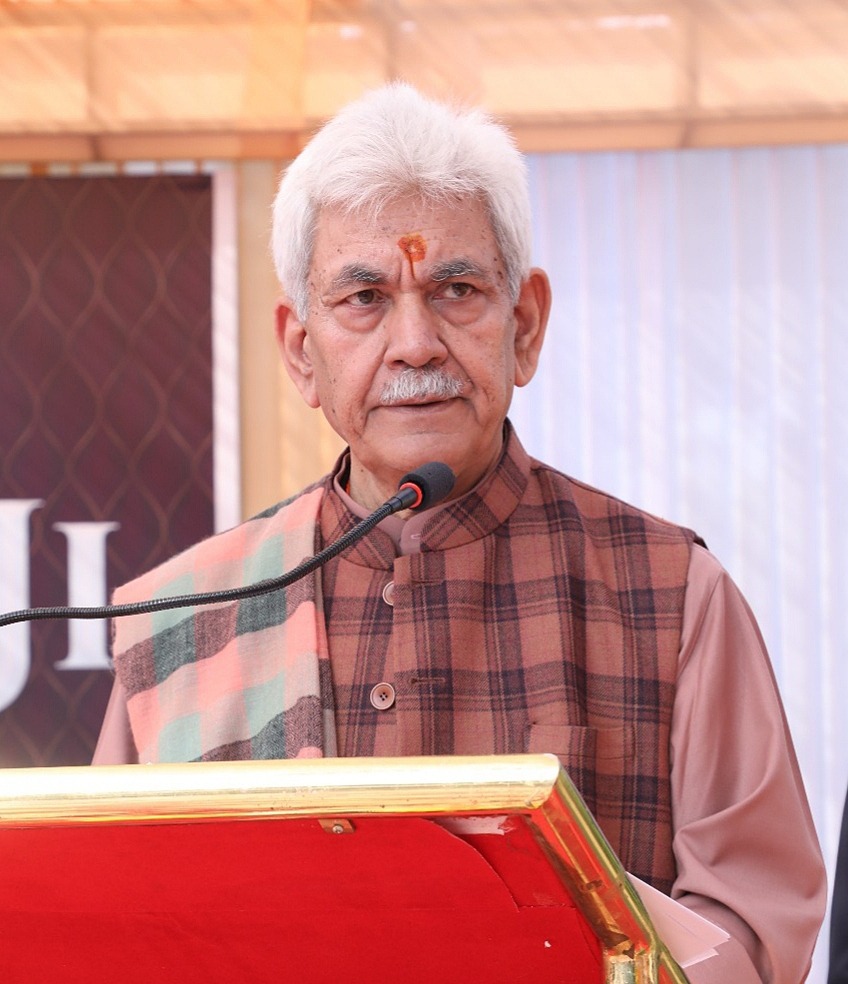
Lieutenant Governor, Manoj Sinha today addressed the Quaternary Healthcare & Research Summit in Srinagar. He emphasized that the summit marks a turning point in Jammu Kashmir and India’s healthcare journey, where the Union Territory and the nation must move beyond tertiary care and embrace quaternary-level treatment and research to ensure equal access for all citizens.
Recalling his visit to Akhnoor during the “Back to Village” programme in 2020, the Lieutenant Governor shared a poignant interaction with doctors who discussed diagnosis for rare diseases and need for modern equipment. He said this moment revealed the greatest distance confronting us in the UT is the gap between healthcare available in small district hospitals and the healthcare actually required. The Lieutenant Governor stressed that bridging this gap is a national priority.
The Lieutenant Governor highlighted India’s remarkable progress under the leadership of the Prime Minister, Narendra Modi. He said free treatment for more than 56 crore citizens surpassed the combined population of the US, France, Italy, and the UK. He said annual vaccination campaigns in the country covering 7 crore children, equal to the population of the UK. He said even e-Sanjeevani telemedicine providing care to 37 crore people annually, exceeding the population of the US.
“Expansion of infrastructure with 23 AIIMS, 2,045 medical colleges, and in Jammu Kashmir, 2 AIIMS, 10 medical colleges, 2 State Cancer Institutes, a Bone and Joint Hospital, a Paediatric Hospital, 52 nursing colleges, 23 paramedical colleges, and 5 pharmacy colleges are providing robust support to healthcare ecosystem. These figures show that India has succeeded in elevating primary, secondary, and tertiary care. But the time has come to scale up tertiary hospitals into quaternary centres,” the Lieutenant Governor said.
The Lieutenant Governor also stressed that the advanced care must no longer remain a luxury confined to metropolitan cities.
“Quaternary care should not be a privilege reserved for the economically rich section of society. It must become a right of citizenship and a guarantee of the nation.
For a very long time, quaternary care has been viewed as a luxury available only in metropolitan cities and accessible only to those who can afford it. I wish to state clearly from this platform that this era must now come to an end. The cooperation of all the stakeholders, private hospitals and research centres is essential for fulfilling this resolve,” he said.
He called upon hospitals to transform themselves into research institutions capable of organ transplantation, robotic and precision surgery, advanced genomics, cellular therapies, and AI-supported diagnostics. He urged hospitals to allocate annual budgets for specialised infrastructure such as modern operating theatres and proton-beam therapy facilities.
“We must always remember that a quaternary centre should be capable of offering every diagnosis and treatment permitted by science. Therefore, hospitals will also have to make budgetary provisions to access expensive and modern technologies such as robotic surgery, gene therapy, proton-beam therapy and artificial-intelligence-based advanced diagnostics.
While preparing the annual budget, hospitals should allocate funds each year for specialised infrastructure. This will enable them to gradually develop facilities such as modern operating theatres for delicate and complex procedures,” he said.
The Lieutenant Governor also suggested building of a new corridor to connect district hospitals and tertiary centres directly with quaternary-care institutions, accelerating diagnostics, imaging, and specialist consultations. He said telemedicine and AI-enabled diagnostic tools should be integrated into standard healthcare infrastructure.
The Lieutenant Governor appealed for expanded fellowship and training opportunities in organ transplantation, oncology, genomics, and critical care.
“Advanced care is impossible without advanced specialists,” the Lieutenant Governor said.
The Lieutenant Governor also suggested a mission uniting Himalayan states, Jammu Kashmir, universities, hospitals, private institutions and innovators to jointly advance biomedical research and overcome funding challenges.
“We must develop new inventions ourselves instead of importing innovation from abroad,” he said.
The Lieutenant Governor urged that hospitals be regarded as strategic national assets just like highways and ports, ensuring their preservation and development with equal dedication.
“We must create a robust quaternary-care framework that guarantees equal access to the son of a farmer and to a millionaire living in a city. This task will not be easy, but it must be undertaken as a matter of national dedication and service. Let us work together at this summit to prepare a strategy that will be remembered for the precise and effective implementation of these goals,” he said.
On the occasion, the Lieutenant Governor released Summit Souvenir and several publications.
Dr. M. Srinivas, Member, NITI Aayog; Shri Atal Dulloo, Chief Secretary; Dr. Digambar Behera, President, National Academy of Medical Sciences; Dr. Kameshwar Prasad; Shri M Raju, Commissioner Secretary, Health & Medical Education Department; Prof. M. Ashraf Ganie, Director SKIMS; heads of various institutions, researchers, scientists, and senior officials were present